My Experiences With The Farmall Tractor - Mel Bockelman
Written by Mel Bockelman, editted by Mark Stephenson - May 12, 2020
Introduction
From time-to-time, we receive wonderful emails with family and personal stories and experiences. Recently, I received one such email from Mel Bockelman in LaFayette County Missouri.
Here are Mel's recollections and a few family photos for you to enjoy. And if you have a family history or story that speaks to our national farming heritage, please contact us via email. Enjoy!
Experiences with our 10-20 McCormick Farmall Tractor (back in the late 1930's and early 1940's)
My Dad, Louis Bockelman, and his growing family lived on a 165-acre farm in Lafayette County Missouri. Interstate 70 split Lafayette County in two and our farm was a half a mile south of the highway, and nearby the town of Higginsville which was then known as the “Seedcorn Capital of the USA”
My Dad bought a repossessed Farmall tractor from a farm implement dealer in nearby Concordia, MO. It was identified as a 10-20 Farmall Tractor which ranked its power between that of a F-12 and a F-20 Farmall Tractor.
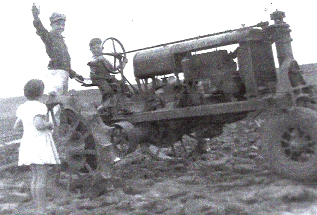
This tractor burned kerosene, which didn't create much power. Dad had a high compression head installed in the engine, that created quite a bit more power, however, it required burning gasoline. Dad also had the “angle bars” on the rear wheels removed and added “cleats” which gave the tractor more traction.
I was about 14 years old and decided to crank the tractor up since starters weren't universally installed in tractors at that time. Most all tractors had a hand crank hanging on the front of the engine for starting. I failed to put my right thumb on top of the crank instead of below the crank handle, and the highly compressed engine back-fired, throwing me backwards about 8 feet. Instantly, my right arm bones were broken, with the pain putting me into near shock.
 Although my dad had four mules and two horses, that tractor did a lot of hard work. In those days, ground was always plowed and dad bought a two-bottom plow which did the “heavy work”. Dad adapted some of his other farm machinery to being pulled by the tractor and soon began to phase out the mules and horses which us boys were very happy about. My Grandpa who immigrated from Germany was upset when he learned farming with mules was a thing of the past.
In fact, dad took on some custom work for other nearby farmers. He charged $2.50 an acre for plowing their ground. Remember, planting seed without plowing the ground had not yet been introduced to the farming community. We boys did the tractor work but dad got the money the farmers paid for plowing their ground.
I recall, driving the tractor all day. Plowing corn ground was tiresome. Add to that, the tractor did not have shock proof steering, and it was often tiresome to keep the tractor going steadily forward correctly.
Riding the tractor during cold weather was not very comfortable. I recall my hands got very cold steering that steering wheel. I often stopped the tractor, taking off my cold leather gloves to let the hot exhaust blow into the gloves until they were very warm.
I recalled one dangerous task we performed. When the tractor's gas tank was low on fuel, in an effort to keep plowing, we didn't stop and turn off the tractor to fuel it, we just idled the tractor as we lifted a ten gallon container filled with gas and turned it over, putting the spout down into the gas tank. With gas gurgling down into the tractor's gas tank, drops of gas sometimes spilled out on the hot part of the engine's manifold, which could have started a fire. In an effort to keep moving we used this shortcut which, if a fire was started, it could have started a fire burning us humans and ruining the tractor.In those days, putting anti-freeze into the radiator was not yet well developed. During the winter months, we always drained water out of the tractor's radiator when we finished a day's work. The next time we started up, we filled the radiator with water.
World War II came in 1941. And gas was rationed, 3 gallons per week for just pleasure driving. Farmers and defense plant work got addition gas allocations. But for the non-defense plant workers three gallons of gas didn't go very far. Most cars built in those days got only 10 to 12 miles per one gallon of gas.
I had a friendly feeling toward that tractor and felt sorry when dad traded it off on a new tractor, after WWII was over. I often thought of the tractor was like a hard-working human being. Finally, I decided to put my thoughts to writing a poem about that tractor even though I had no experience in writing poems.
After about 4 months of working and re-working the poem, I finished it. The family didn't think much of it so I sent it to the International Poetry Commission. Attached is a copy of their reply.
I thought, and they agreed, that this poem adequately described my feelings to that beloved tractor.This Tractor Speaks It's Mind - by Melvin Bockelmal
I'm a worn out tractor, that's for sureI was a powerful mean machine
I snorted, grunted and chugged ahead
Plowing, disking and planting seed
But now I'm an old decrepit piece of iron
Just waiting to be melted down
Spending my last days in this stinking weed patch
Pondering my fate like a worn out cow
Wish someone would take pity on me
And give me a second chance
Scrape that rust from my tough old frame
Get me out of this wretched place
Tune my engine like a kitten purrs
Check my gears for wear
Scrub me down till I'm very clean
Crank me up and I'll snort like a bear
Pretending that I'm still that old mean machine